
When I have the time and inclination, I like to bake my own bread and rolls. Recently, I came across a recipe for a Japanese white bread called “Shokupan” and was interested in making it myself.
While browsing the internet for more information on making this specific bread, it was repeatedly emphasized that you should definitely use flour with 12.7% protein. So, I went to my pantry and looked at how much protein my stock of different types of flour had. One of them had exactly the requested amount, so I got to work right away.
Only later did I read that it was actually not the right type of flour typically used for Shokupan. Therefore, here is a somewhat longer explanation than I usually give in my recipes. The difference is extremely interesting concerning the differences between the flours.
The flour I used for my first attempt was durum wheat flour. But for this particular bread soft wheat flour is usually used.
What makes the difference?
The main difference between soft wheat flour and durum wheat flour lies in the protein content, the gluten structure and the resulting baking properties. While soft wheat flour is ideal for soft, light baked products such as cakes and pastries, durum wheat flour is the basis for firm pasta and some types of bread.
Comparison of Wheat Flour and Durum Wheat Flour
| Characteristic | Soft wheat flour | Durum wheat flour |
| Protein content | Lower protein content. | Higher protein content (often over 13%). |
| Gluten structure | The gluten is elastic, which means that the dough springs back to its original shape when kneaded. | The gluten is more stretchy and less elastic. It can be stretched more easily without tearing but doesn’t spring back as much. |
| Volume | Rather small, results in a finely crumbly bread. | High, produces a rustic, grainier bread. |
| Crumb structure | Soft and delicate. | Firmer and tougher. |
| Crust | Thinner and less crispy. | Thick, crispy and often with an intense golden yellow colour. |
| Baking behavior | Easier to process, but less absorbent for water. | Requires more water and can result in a firmer dough, but it rises well. |
Different protein contents lead to different baking properties:
Durum wheat flour forms a stretchy, but less elastic, gluten network when water is added. This is ideal for pasta that needs to retain its shape during cooking, but less suitable for fluffy baked goods. It is often used to make rustic, Mediterranean bread. Durum wheat gives bread an intense, nutty flavor and a golden yellow color.
Soft wheat flour produces a less pronounced gluten network, resulting in a more tender dough that becomes light and soft during baking.
Depending on the type of soft wheat flour, the flavor is rather neutral and is ideal for soft white breads, rolls, sponge cakes, and cakes.

Which flour to use for Shokupan bread?
Shokupan is usually made from soft wheat flour with a relatively high protein content.
Compared to regular, low-protein soft wheat flour, it is best to use flour with special high-protein soft wheat flour. This is often referred to as “Manitoba flour” or simply “high-protein bread flour.” It comes from soft wheat varieties that are naturally high in protein. Manitoba flour originates from the Manitoba region of Canada. It often has a protein content of over 14% and is known for its strength and good water absorption.
Some mills also offer “high-protein” wheat flours with 12% to 14.5% protein.
In Japan, a special bread flour (kyoryokuko 強力粉) is used for Shokupan, which also has a high protein content of 11.5–12.5% and differs from standard European flour.

If you want to bake Shokupan, it’s best to use high-quality wheat flour with minimum 12.7% protein and follow a recipe that uses the Tangzhong method to achieve the desired texture. Tangzhong is a preliminary step in the dough making process, in which flour is boiled on medium heat with water (and/or milk) in a ratio of approximately 1:5, while stirring continuously. The goal is to gelatinize the starch in the flour and thus achieve better water retention in the final dough. Heating creates gel-like structures that not only make the crumb softer and moister but also improve its freshness. The Tangzhong is incorporated into the main dough after cooling. It is recommended to prepare it the day before and store it in a tightly sealed container in the refrigerator.
Living in Greece, I needed to look for a flour suitable to make Shokupan, and found an Italian brand called Caputo. It is available in many supermarkets. It is declared as a 00 flour which usually is used for pizza dough. Looking up at other 00 flours on the shelf, most of them did not meet the protein needed for Shokupan, so have a close look before you buy.
My experience with the two different flours
After baking a loaf with both flours and the same recipe, I’ve come to the conclusion that the truly striking difference lies in the crust.
While the crust was crispy and golden brown with the durum wheat flour, the crust with the Caputo flour was soft and elastic. When pressed with my finger, it returned to its original shape.
In my opinion, the crumb of both flours had a light and airy texture, perhaps a little fluffier with the Caputo flour than with the durum wheat flour.
The fact that the bread with durum wheat flour turned out light and fluffy is certainly also due to the use of fat (butter), egg and milk, as well as the Tangzhong, since soft wheat flour naturally has a loose structure, as already explained above.
The kneading technique is crucial in Shokupan. Kneading is carried out until the dough passes the “windowpane test.” This means that the gluten network is optimally developed to trap the gases of the yeast dough and achieve maximum extensibility and elasticity. A particularly careful and long kneading phase can also produce a softer result with durum wheat flour by making the best possible use of the available gluten.

What amazed me most about Shokupan bread was its toasting properties. While regular, commercially available toast bread browns quickly and dries out on the inside, a slice of Shokupan takes quite a while to brown in the toaster but still remains fluffy and light on the inside—regardless of whether it’s made with soft or durum wheat flour.
For both experiments, I bought a Pullman loaf pan. This is a loaf pan with a lid. In my first attempt with durum wheat flour, I baked the bread without a lid. In my second attempt with Caputo flour, I baked it with a lid. The result can be seen in the photos.

What to consider when using butter, egg and milk in the preparation of Shokupan
Fats added to dough act as a film covering the yeast and preventing it from absorbing the air it feeds on, isolating water and other nutrients and slowing fermentation. Therefore, it’s important to add the fat in several stages at the end, as described in this recipe. Remember that the fats must always be thoroughly absorbed before adding the next portion. Butter relaxes the gluten bonds, making the bread last longer. It should be added at room temperature.
Traditional bread is baked at a temperature of 200-220°C. Milk contributes to the softness of the bread, and the lactose also contributes to the coloring of the crust, so breads containing milk should be baked at lower temperatures (175°C) to prevent the crust from burning. Some Shokupan recipes recommend using powdered milk. This results in a soft bread without making the dough too runny.
The addition of eggs colors the dough, making it homogenous and smooth, and extends the shelf life of the bread. As with bread containing milk, breads containing eggs should be baked at a lower temperature to prevent the crust from burning.
What you need:
For the Tangzhong
20gr flour with 12.7% protein
50gr water
60gr milk 2%
For the dough
10gr dry yeast
20gr lukewarm water
380gr flour with 12.7% protein
20gr sugar
10gr honey
3gr salt
130gr milk 2%
1 egg
3 Tbsp soft butter (not melted, room temperature, appr. 60gr)
1 egg yolk
1 Tbsp milk 2%
How to prepare
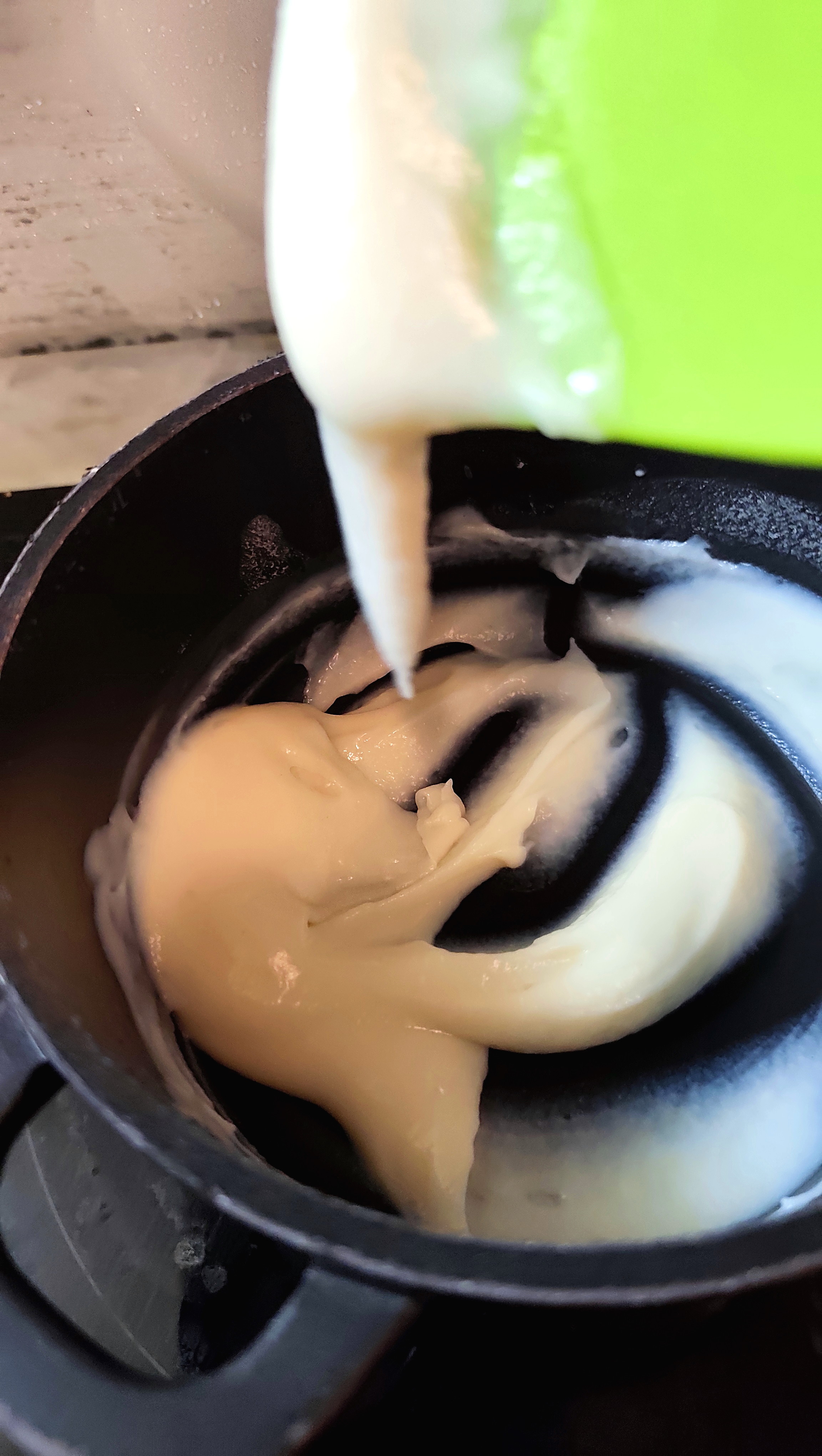
For the tangzhong, combine the flour with water and milk in a small saucepan. Cook over medium heat, stirring constantly, until a pudding-like consistency forms. Let cool, then cover with plastic wrap or store in a tightly sealed container to prevent the tangzhong from forming a skin or drying out.
Mix the yeast with the lukewarm water and set aside.
Combine flour, sugar, and salt. Add honey, room-temperature Tangzhong, yeast, milk, and egg. Mix thoroughly with a dough hook until a smooth dough forms that pulls away from the sides of the bowl. This will take about 7-10 minutes.
Stir in the butter a spoonful at a time. Knead the dough until the butter is fully incorporated before adding the next spoonful. This takes about 3-5 minutes per spoonful, and the dough should begin to release from the bowl.
Then knead the dough again for about 5 minutes.
Form a ball, add some vegetable oil to a clean bowl, add the dough, cover with cling film and let it rest in a warm place for at least 1 hour or in the refrigerator overnight.
When the dough has doubled in size, place it on a floured surface and roll it into a log. Divide the dough into 3-4 equal pieces (it’s best to weigh them).
Roll each piece into a long, narrow rectangle. Fold one long side toward the center, overlap the other long side, and then tightly roll up from the short side. Place the rolls side by side in an oiled Pullman pan.
Cover and let rest for another 30 minutes. It’s also possible to let the dough rise in the bread pan overnight in the refrigerator, then bake it fresh the next day. To do this, let the pan warm up for about an hour before baking.
Preheat the oven at 175 °C.
If baking the bread without a lid, mix the egg yolk with the milk and brush it over the top of the bread. If using the lid of the Pullman baking pan, add a little oil to the inside of the lid to prevent the dough from sticking to the top.
Place the baking pan on the bottom rack to allow enough room for the bread to rise during baking.
Bake for 40–50 minutes. The bread is done when you hear a hollow sound when you tap the top.
Then let it cool in the baking pan for 20–30 minutes before removing it from the pan.
| Nutrient | Total (whole recipe) | Per 100 g |
| Energy | 2,190 kcal | 257 kcal |
| Protein | 72 g | 8.5 g |
| Total Fat | 79 g | 9.3 g |
| Saturated Fat | 48 g | 5.6 g |
| Carbohydrates | 348 g | 41 g |
| Sugars | 33 g | 3.9 g |
| Fiber | 10 g | 1.2 g |
| Sodium | 1.2 g (1200 mg) | 140 mg |
Discover more from Eat Good Live Good
Subscribe to get the latest posts sent to your email.
 Eat Good Live Good